A presentation of work from the publishing office of a creative mind in Amsterdam
Mind reader closes the Amsterdam Magic Festival
Evan Kastor closed the inaugural festival to a standing ovation. Earlier in the week, he mounted
his latest production, Familiars. Centered around familiar spirits, Familiars is
the latest in Kastor's annual mind-bending productions. This one is a spiritual successor to
“The Rose Séance Experiment.” Described as “completely
inexplicable” and “riveting,” anticipation is high for next year's show:
Murder in Mind. Kastor is now booking private events and his keynote talk,
“Mastering Intuition.”
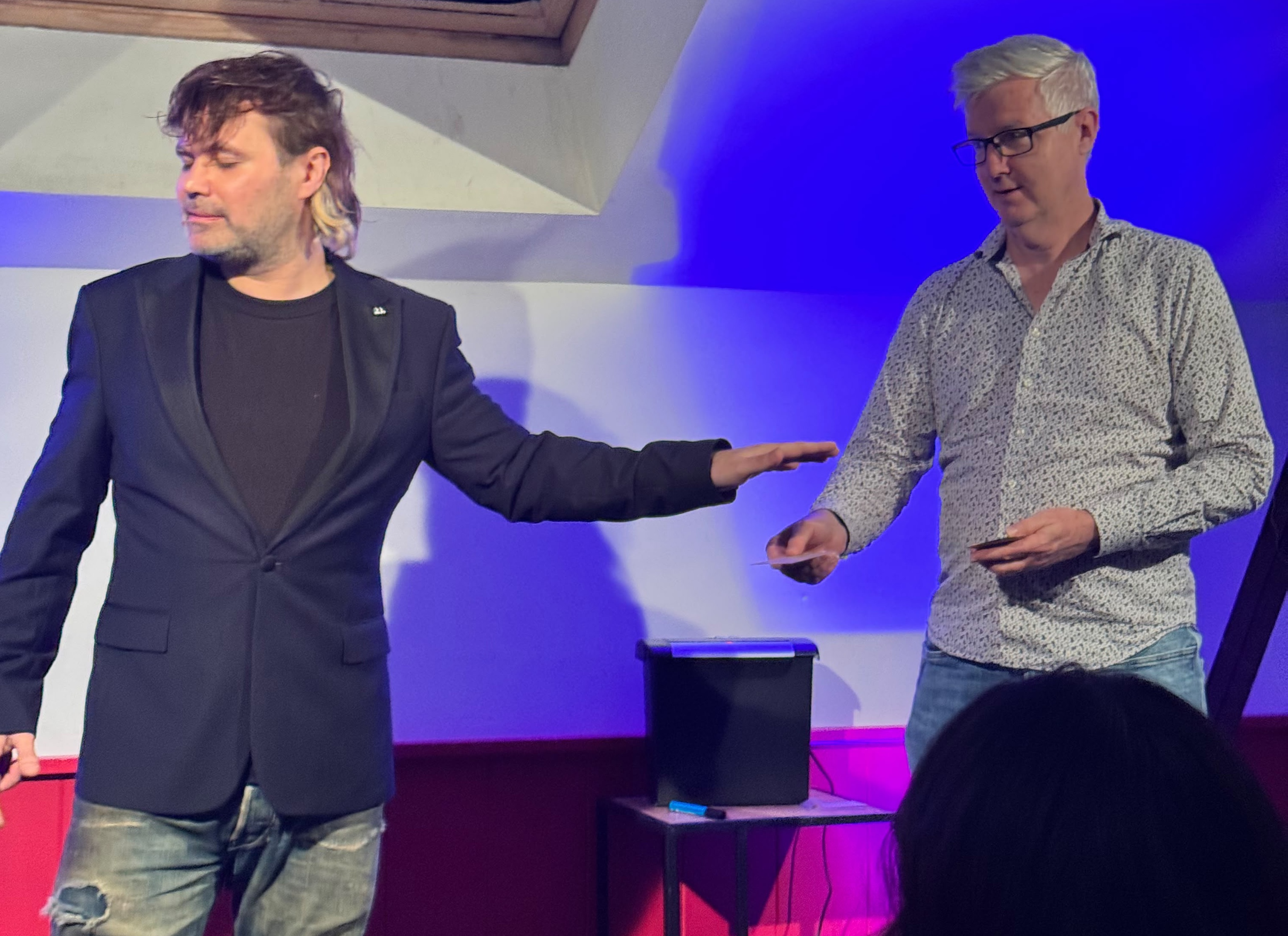
In this keynote, Kastor delves into the techniques he has used for many years to get in
touch with, and foster, his intuition. Techniques that help inspire creativity, and
solutions in the workplace. He follows this with a demonstration of mind reading using
members of the audience.
Guest Interview
From Screen to Stage
How do you translate the magic of visual effects on screens into real-life magic for the
theatre?
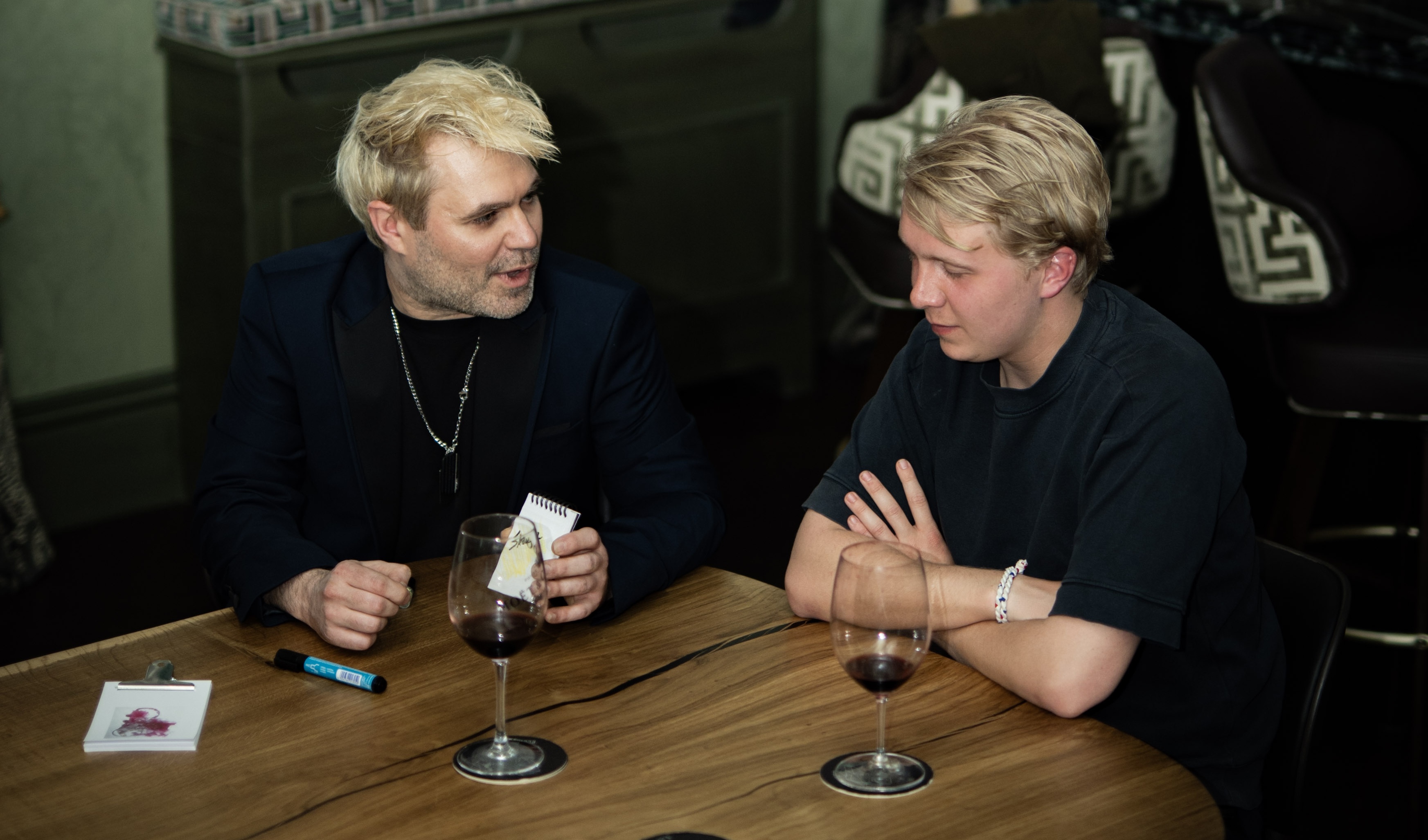
Evan Kastor sits down with West End illusion designer Chris Fisher, whose credits include
Harry Potter and the Cursed Child and Stranger Things: The First Shadow, to find out.
Exciting Light has been named lighting designer of the year for music event lighting by
the second annual LIT Awards for their work on the Mad Fox Club, now called Do Not Disturb in
the W Hotel, located in Dam Square in Amsterdam.
How do you translate the magic of visual effects on screens into real-life magic for the
theatre? I had the great fortune of getting to ask Chris Fisher just that. Chris is one of
the illusion designers whose creations have captivated West End audiences nightly for
almost a decade now in Harry Potter, The Cursed Child (2016) and more recently, Stranger
Things, The First Shadow (2023).
We are all familiar with Harry Potter and his years at Hogwarts, a world that has entranced
generations of children and adults since the first book came out in 1997. The screen
adaptations of the books were well done and gave us a yearly glimpse into the magical
Hogwarts. The magic was primarily achieved with visual effects added in post-production, as
most effects in movies are.
Bringing Hogwarts and its inhabitants to the stage simultaneously brought a whole new
theatre-going audience, one that expected to see the movies happening live. This new
audience demanded the production create and perfect new theatrical techniques in every
department. For instance, it is easy on-screen to cut between conversations and storylines
rapidly, no scene changes necessary. This new audience wouldn't wait for actors to walk into
position, get set and begin a scene.
So, how did they solve this? Embedded in the stage is a giant turn table. Set pieces and
actors can be preset upstage while scenes are finishing downstage, then rapidly spun into
position with the actors immediately beginning the next bit. Additionally, actors can walk
naturally and chat with their scene partners while the turntable keeps them in the same
place in space, like a giant treadmill.
The Harry Potter and the Cursed Child stage set, built around a giant turntable.
Chris and the team also pioneered an impressive new category of stage illusion, scene
change magic. These are whole bits not driven by the needs of the plot but to speed up
scene changes. For instance, one scene in Cursed Child requires two actors to begin their
scene talking in a bed. There is nothing magical in the plot here, but in the production, an
empty bed is wheeled into position downstage, and the sheet is placed on top. By the time
the sheet hits the empty bed, our two actors magically appear in the bed, ready to play the
scene.
The end result of all these new techniques is an entire theatrical experience that is as
close to the screen versions as possible, combined with the immersion of a theme park. This
world-building is also the case for Stranger Things, which includes a giant turntable and
many of the same theatrical devices as Harry Potter. It is no surprise, though, as it is
from the same producers. Let's find out more from Chris Fisher.
E: What are the biggest differences in approaching the magic of Harry
Potter and the effects in Stranger Things?
C: There are, of course, lots of differences between the two canons, not
least that Stranger Things is a lot more scarier than Harry Potter! The initial approach is
actually pretty much the same, in that you take the script, look at the story and devise
effects that can be woven into the story and narrative, as well as into the design.
The difference of the two worlds though meant that we had to consider more what it was we
were creating. With Harry Potter, it is very much a world of magic and spells. We do create
a magical environment that the play exists in, but we are also creating magic that is
"cause and effect"; for example, a wand is pointed at something, a spell is said, and an
effect happens. A bit like when magicians perform their shows. Stranger Things is very
different in that it is not a 'magical' world. It's a world where very odd, unexplained
things can and do happen, but it's a different genre.
The actual series has telekinesis, monsters and horrifying acts. It's got suspense and jump
scares. And these are things that we need to try and bring to the stage. We worked very
closely with one of the scriptwriters from the series to work out what the moments could be
and spent months developing the ideas. Stranger Things, in a way, had to be a lot more
realistic for the horror to hit.
E: What were your biggest challenges in translating VFX magic to real-life
stage magic?
C: I always like to think that anything that can be created on a screen, I
can recreate a version of it in live action. Obviously, video effects and CGI can create
certain impossible moments, but there is nothing like seeing one of those moments live
onstage in front of your very eyes. That's what has been exciting about working on these
massive shows in that it has brought a TV/cinema audience to the theatre, a lot of whom have
never seen a live theatre production before. They have their minds blown by seeing these
effects live.
What was extremely interesting and exciting working on Stranger Things, though, was that we
did manage to blend the world of AV and illusion more than I've ever done before, working
with the brilliant company 59 Productions, who were co-visual effects alongside Jamie
(Harrison, co-designer) and me. We workshopped a lot of things together, taking a lot of the
principles of magic and mixing them with a lot of their equipment and ideas. It has created
some truly spectacular moments. A great example is when Henry produces live smoke from his
hand that then seems to spread and morph in the air to become a much larger smoke cloud.
This mixes an on-person smoke device coupled with brilliant projection onto a hologauze.
E: How was it working with other departments (like lighting, rigging,
video, set and prop designers), knowing they would have to be on board to help create the
magic?
C: I always say that creating illusion and magic is actually one of the
hardest roles on a production because we actually do straddle across almost every single
department on the show. Just one effect alone will depend on the collaboration with the
designer, director, choreographer, automation, stage management, props, costume, lighting,
sound and wigs. It is critical that for every single effect I create I have thought about
what I need from each of those departments. Then follows a lot of meetings as I talk through
all the departments exactly what is needed to create the effect. I will then usually make
prototypes, do workshops and make sure that everything I have designed is going to work.
We'll often get actors in to help us with this, too. It's highly collaborative, as I
mentioned, and it's important I work closely with all the other designers to make sure the
effects are integrated into all of their world, too. An effect should never feel
'shoe-horned' in, as you can see it from a mile. The best effects are when they seamlessly
come from nowhere and are the least expected. You do need to trust the departments, but with
the right communication and hard work, we can all come together to create some true
miracles.
E: The time warp in Harry Potter and Henry's mother's last moments 'by' the
dinner table in Stranger Things got me. The time warp is incredible, when they do the actual
'time jump' the whole stage shifts and ripples in a way that is truly impossible. Henry's
mother's last moments replicate a signature visual from season 4 that is, likewise,
impossible. These were my favourite moments, what are your favourite magical moments in the
shows?
C: I'm a fan of both of those, too, and I always enjoy watching people's
reactions to them! In Harry Potter, a couple of my favourite moments are the paper stacks,
when Harry waves his wand and all the messy papers on his desk suddenly correct themselves
and also Polyjuice, which is so much fun to watch. The paper stacks are particularly
satisfying as they are something that wasn't in the show originally, and we devised the
method during rehearsals. We made prototypes out of paper and it worked so well we developed
it further to what we have today. The joy of the effect is like I mentioned above about the
collaboration with other departments. The effect works really well, but what really sells
it is the flash of light on the papers when the spell hits and the sound effect of the
papers flapping across the table. This makes it feel like real magic!
In Stranger Things, I think one of my favourite moments is when the rat explodes. People
are convinced that the rat is real (and perhaps it is!), but that effect uses a combination
of basic 'box' principles a lot of magicians would probably know, but with lots of
convincers and subtleties that steer you away from this. It was a very complicated (and
expensive!) build but it totally pays off.
E: One last thing, was that a spider squirmle I saw in Stranger Things?
C: Haha, well spotted!! Yes, there is a moment towards the start when Henry
takes a spider from under the floorboard, plays with it in his hands, and then places it
into his suitcase. And the idea for how to do that was totally the squirmle!
A huge thank you to Chris for taking the time, in the middle of teching a new show, to shed
some light on these two outstanding productions.
Harry Potter and the Cursed Child is currently running in London (and many other
cities), and Stranger Things, The First Shadow, is running in London through February
2025.